Introduction
The way commercial buildings manage heating, ventilation and air conditioning is changing rapidly. With increasing electricity consumption, rising cooling requirements, growing environmental concerns and the demand for healthier indoor environments, traditional air conditioning systems are no longer sufficient for modern commercial infrastructure.
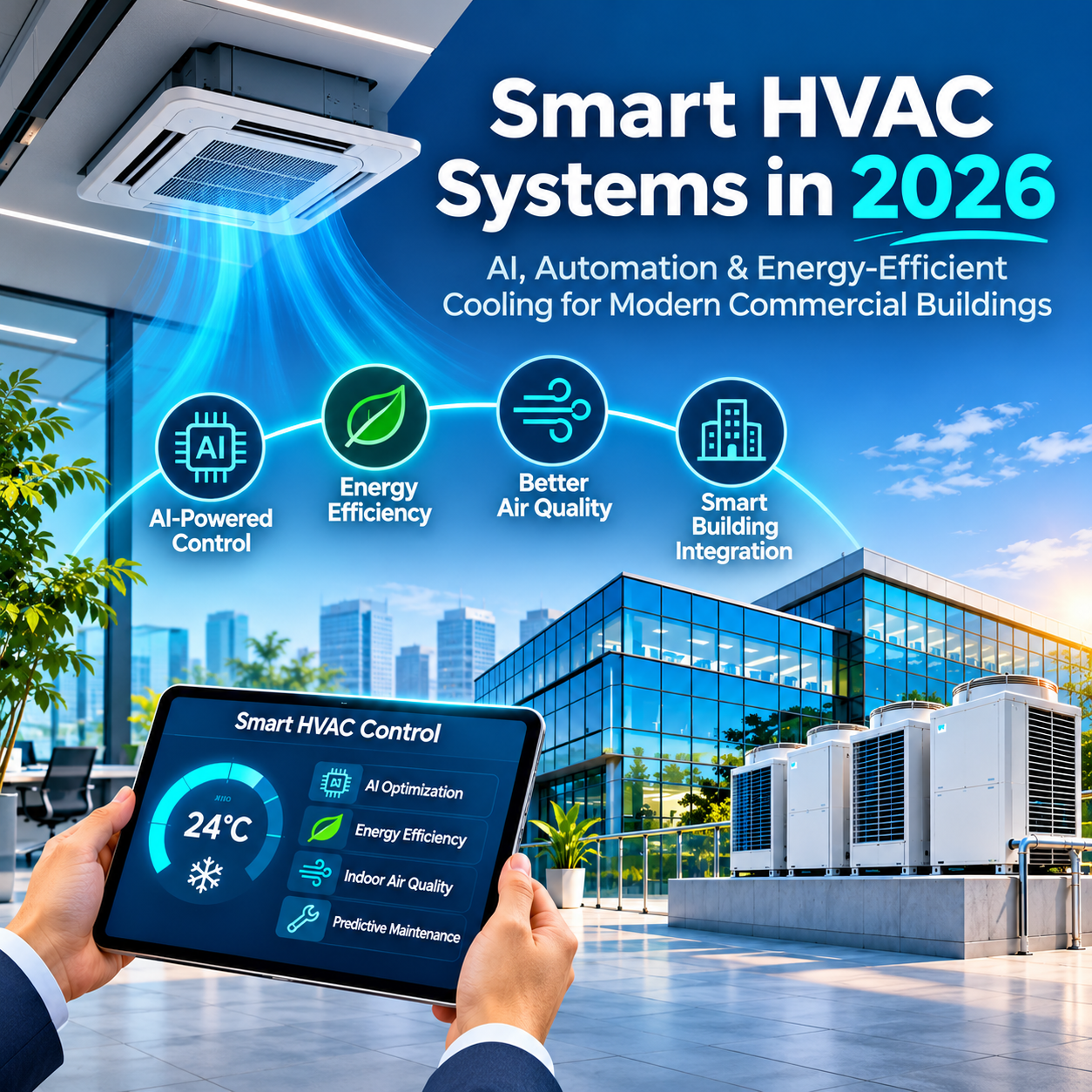
In 2026, smart HVAC systems, artificial intelligence (AI), automated temperature controls and energy-efficient cooling technologies are becoming important considerations for businesses, commercial property developers, hospitals, hotels, IT parks and industrial facilities.
India’s rapidly expanding commercial infrastructure is creating a greater need for advanced HVAC solutions that can maintain indoor comfort while optimising energy consumption. According to the International Energy Agency (IEA), integrating energy efficiency with smart digital technologies can help buildings optimise electricity use, reduce peak demand and improve energy flexibility.
But what exactly makes an HVAC system smart? How can businesses benefit from modern cooling technologies? And what should you consider before investing in a commercial HVAC installation?
Let’s explore the latest HVAC trends and technologies shaping commercial buildings in India in 2026.
What Are Smart HVAC Systems?
Smart HVAC systems are advanced heating, ventilation and air conditioning solutions that use intelligent controls, sensors, automation and connected technologies to manage indoor environmental conditions.
Unlike conventional air conditioning systems that operate using fixed temperature settings, smart HVAC solutions can adjust their performance according to factors such as:
- Indoor and outdoor temperature.
- Occupancy levels within different areas.
- Humidity and indoor air quality.
- Cooling requirements across different zones.
- Equipment operating conditions.
- Electricity consumption and operating schedules.
Depending on the system architecture, smart HVAC technology can also integrate with Building Management Systems (BMS), allowing facility managers to monitor and manage multiple building systems through a centralised platform.
The primary objective is to maintain comfortable indoor conditions while improving operational efficiency and reducing unnecessary energy consumption.
Top HVAC Trends Transforming Commercial Buildings in 2026
The HVAC industry is experiencing significant technological changes. Here are some of the important developments businesses should understand when planning new commercial HVAC installations.
1. AI-Powered HVAC Systems and Predictive Maintenance
Artificial intelligence is emerging as an important technology in modern HVAC management.
AI-powered HVAC platforms can analyse operational information collected through temperature sensors, humidity monitors, occupancy sensors and equipment monitoring systems.
Using this information, intelligent control platforms can help identify operating patterns, optimise temperature settings and detect unusual equipment behaviour.
How AI improves HVAC operations:
- Identifies unusual equipment performance.
- Supports predictive maintenance planning.
- Helps optimise cooling schedules.
- Identifies potential energy wastage.
- Supports more efficient equipment operation.
- Helps facility managers make informed maintenance decisions.
For example, an AI-enabled monitoring platform in an office building may identify that certain meeting rooms remain unoccupied for extended periods. Where the HVAC controls support occupancy-based operation, cooling can be adjusted to match actual requirements.
Research published in 2026 in the journal Building and Environment reviewed AI-driven HVAC optimisation and reported promising energy-efficiency improvements across studied applications. However, actual savings depend on building conditions, system design, controls and real-world implementation.
2. Energy-Efficient VRF and VRV Air Conditioning Systems
Variable Refrigerant Flow (VRF) and Variable Refrigerant Volume (VRV) systems are increasingly relevant for commercial buildings that require flexible and zoned cooling.
These systems regulate refrigerant flow according to the cooling or heating requirements of individual indoor units.
Instead of operating every indoor unit at the same capacity, VRF/VRV technology allows different zones to maintain different temperature settings.
Key advantages of VRF/VRV systems:
- Independent temperature control across multiple zones.
- Flexible installation for commercial applications.
- Variable-capacity operation.
- Suitable for offices, hotels and institutional buildings.
- Centralised monitoring options with compatible controls.
- Potential for improved part-load efficiency when correctly designed.
VRF and VRV systems can be particularly useful in office buildings where meeting rooms, cabins, workstations and common areas have different cooling requirements.
Selecting the right system requires proper heat-load calculations, building layout assessment and equipment selection.
3. Indoor Air Quality Is Becoming a Major HVAC Priority
Modern commercial HVAC design is no longer limited to maintaining comfortable temperatures. Indoor air quality (IAQ) is becoming an equally important consideration.
Offices, hospitals, educational institutions, hotels and commercial spaces need appropriate ventilation and filtration strategies to maintain healthier indoor environments.
An effective HVAC design considers the balance between conditioned air, fresh-air supply, filtration and exhaust ventilation.
Important indoor air quality considerations include:
- Adequate fresh-air ventilation.
- Appropriate air filtration.
- Humidity management.
- Carbon dioxide monitoring where appropriate.
- Control of indoor particulate matter.
- Proper exhaust air management.
- Regular filter inspection and replacement.
For example, a corporate office with insufficient ventilation may experience poor air circulation and increased indoor pollutant levels.
A properly designed HVAC and ventilation system can help improve indoor environmental quality while maintaining appropriate cooling performance.
4. Smart Building Automation and BMS Integration
Building Management Systems are becoming an important part of modern commercial infrastructure.
A BMS can connect HVAC equipment with other building systems, providing centralised monitoring and control.
Depending on the configuration, a BMS may monitor:
- Air handling units (AHUs).
- Chillers and chilled-water systems.
- Pumps and cooling equipment.
- Temperature and humidity sensors.
- Ventilation equipment.
- Energy consumption.
- Equipment operating schedules.
For large commercial facilities, centralised monitoring can simplify facility management and help identify operational problems.
For example, a facility manager managing multiple office floors can monitor temperature conditions and equipment status from a central interface rather than checking every individual unit.
Integration compatibility should always be verified during the HVAC design and equipment selection stage.
5. Energy-Efficient Chiller Systems for Large Commercial Buildings
Chillers are essential components of centralised cooling systems used in large commercial and industrial facilities.
They are commonly installed in:
- IT parks and corporate offices.
- Hospitals and healthcare facilities.
- Shopping malls.
- Hotels and hospitality properties.
- Manufacturing facilities.
- Large institutional buildings.
Modern chiller selection focuses on cooling capacity, operating efficiency, load variations, maintenance requirements and long-term operating costs.
Important considerations include:
Part-load efficiency: Commercial buildings rarely operate at maximum cooling demand throughout the day. Selecting equipment that performs efficiently under varying loads is important.
Variable-speed technology: Compatible variable-speed drives can help optimise pump and fan operation according to system requirements.
Heat rejection: Proper cooling tower and condenser arrangements can influence overall plant performance.
Chilled-water optimisation: Appropriate water-flow rates, temperature differences and control strategies contribute to efficient operation.
Preventive maintenance: Regular inspections, cleaning and performance monitoring help maintain system efficiency.
The right chiller solution should be selected through a detailed assessment of building cooling requirements.
6. Sustainable HVAC and Green Building Solutions
Sustainability is becoming an important consideration in commercial construction and building management.
Businesses are increasingly evaluating HVAC systems based on their electricity consumption, environmental impact, equipment lifespan and maintenance requirements.
Energy-efficient HVAC systems can support broader building sustainability objectives when combined with appropriate building design and operational practices.
Some important sustainable HVAC approaches include:
- High-efficiency air conditioning equipment.
- Optimised HVAC system design.
- Energy recovery ventilation where suitable.
- Efficient pumps and fans.
- Proper duct insulation.
- Smart temperature controls.
- Regular system commissioning.
- Integration with renewable energy systems where feasible.
India’s Energy Conservation and Sustainable Building Code (ECSBC) 2024 also reflects the growing emphasis on building sustainability alongside energy efficiency.
Commercial property developers should evaluate applicable building requirements during the planning and design stages.
Why Energy-Efficient HVAC Systems Matter for Indian Businesses
India’s commercial infrastructure is expanding, and cooling requirements are increasing across offices, healthcare facilities, hospitality projects, factories and institutional buildings.
The Bureau of Energy Efficiency highlights the significant role of buildings in India’s electricity consumption and the importance of improving energy performance in new and existing buildings.
For businesses, HVAC efficiency matters for several reasons.
1. Better Control Over Electricity Consumption
Air conditioning can represent a substantial portion of a commercial building’s electricity consumption.
Correct equipment selection, efficient system design and appropriate operating controls can help avoid unnecessary energy usage.
2. Improved Indoor Comfort
An appropriately designed HVAC system helps maintain consistent indoor temperatures and suitable ventilation conditions.
This is particularly important in environments where employees, customers, patients or visitors spend extended periods indoors.
3. Reduced Equipment Stress
Incorrect system sizing, poor installation and insufficient maintenance can increase equipment stress.
Proper engineering and regular maintenance help support reliable system operation.
4. Better Long-Term Operational Planning
Businesses should consider the total cost of ownership rather than focusing only on the initial installation price.
Equipment efficiency, electricity costs, maintenance expenses and expected equipment lifespan all contribute to the long-term value of an HVAC investment.
5. Support for Sustainable Building Objectives
Efficient cooling technologies and well-designed ventilation systems can contribute to sustainability goals and improved building performance.
How to Choose the Right HVAC System for Your Commercial Building
Selecting the right HVAC system requires more than comparing air conditioning brands or equipment prices.
Every building has different cooling requirements based on its size, occupancy, layout, usage and operating conditions.
Consider these important factors before selecting a commercial HVAC solution.
1. Calculate the Building’s Cooling Load
A professional HVAC assessment should consider:
- Total floor area.
- Number of occupants.
- Building orientation.
- Glass and window exposure.
- Lighting and electrical equipment.
- Outdoor temperature conditions.
- Fresh-air requirements.
Incorrect cooling-load calculations may lead to oversized or undersized systems.
2. Select the Appropriate HVAC Technology
Different buildings require different solutions.
For example:
- VRF/VRV systems can be suitable for multi-zone commercial buildings.
- Chillers can be appropriate for large centralised cooling applications.
- Ductable AC systems can serve larger open spaces.
- Cassette AC systems can be suitable for selected commercial interiors.
- Dedicated ventilation systems can support fresh-air requirements.
The selection should be based on technical requirements rather than choosing equipment solely by price.
3. Evaluate Energy Efficiency
Compare equipment performance using relevant technical ratings and operating conditions.
For larger projects, evaluate system-level performance instead of considering only the rated efficiency of individual components.
4. Consider Indoor Air Quality
Ensure the design addresses fresh-air requirements, filtration, humidity and appropriate exhaust arrangements.
5. Check Installation and Commissioning Capabilities
Professional installation, testing and commissioning are essential for reliable HVAC operation.
A technically appropriate system may still underperform if ductwork, refrigerant piping, electrical connections or control settings are incorrectly executed.
6. Plan for Regular HVAC Maintenance
Preventive maintenance helps identify issues before they become major equipment failures.
Businesses should consider maintenance schedules, service availability, spare parts and annual maintenance contracts when selecting an HVAC contractor.
The Importance of Professional HVAC Design and Installation in Pune
Pune’s commercial and industrial development has increased the need for properly engineered cooling and ventilation solutions.
IT parks, corporate offices, hospitals, hotels, manufacturing facilities and educational institutions all have different indoor environmental requirements.
Working with an experienced HVAC contractor in Pune can help businesses plan their cooling infrastructure more effectively.
Professional HVAC services generally include:
- HVAC heat-load calculations.
- System design and equipment selection.
- VRF/VRV air conditioning solutions.
- Chiller and chilled-water systems.
- Ductable and cassette AC installation.
- Fresh-air and ventilation systems.
- HVAC installation and commissioning.
- Preventive maintenance and technical support.
A complete HVAC solution should consider the building’s present requirements as well as its future operational needs.
How SNOVAC Supports Modern HVAC Requirements
SNOVAC Systems Pvt. Ltd. provides specialised HVAC engineering solutions for commercial, industrial and residential applications.
With experience in HVAC project execution and operations across India and the UAE, SNOVAC focuses on delivering solutions that combine system design, equipment selection, installation and technical support.
Its HVAC services include:
VRF/VRV Air Conditioning: Flexible cooling solutions for commercial buildings, offices and institutional applications.
Chiller Systems: Centralised cooling solutions designed according to building capacity and operational requirements.
Ductable and Cassette AC: Air conditioning options for different commercial and residential spaces.
HVAC Design and Engineering: Technical planning, heat-load calculations and equipment selection based on project requirements.
Installation and Commissioning: Complete execution support to ensure that HVAC equipment is installed and tested appropriately.
Maintenance and Support: HVAC service and maintenance solutions to support long-term system performance.
SNOVAC works with leading HVAC brands, including Carrier, Toshiba, LG, Midea and Hitachi, helping customers evaluate equipment options according to their project requirements.
Whether you are planning a new commercial building, upgrading an existing cooling system or evaluating HVAC solutions for an industrial facility, professional engineering and equipment selection are essential.
Explore SNOVAC HVAC Solutions to understand the available air conditioning services.
You can also contact SNOVAC to discuss your commercial HVAC requirements.
Future of HVAC Technology in India: What Businesses Should Expect
The future of HVAC technology will be influenced by digitalisation, energy efficiency, sustainable construction and the increasing importance of indoor environmental quality.
Some developments worth watching include:
AI-Based Predictive Maintenance
More HVAC systems are expected to incorporate intelligent monitoring and analytics to identify equipment problems earlier and support maintenance planning.
Advanced Building Management Systems
Integration between HVAC equipment, sensors and building automation platforms will improve visibility into building operations.
Better Indoor Environmental Monitoring
Temperature, humidity, ventilation and particulate monitoring will become increasingly important in commercial facilities.
High-Efficiency Cooling Technologies
Businesses will continue to evaluate advanced air conditioning systems, efficient chillers and optimised cooling strategies to manage energy consumption.
Sustainable Building Design
HVAC planning will increasingly be integrated with building orientation, insulation, shading, ventilation and other energy-saving measures.
The opportunity is to design cooling infrastructure that balances comfort, reliability, efficiency and long-term operating costs.
Conclusion
Smart HVAC systems are becoming an important part of modern commercial infrastructure in India. From AI-powered monitoring and automated controls to VRF/VRV air conditioning, efficient chillers and improved ventilation, the HVAC industry is moving towards more intelligent and performance-focused solutions.
For businesses, choosing the right HVAC system is an investment in operational efficiency, indoor comfort and long-term building performance.
However, advanced technology alone cannot guarantee efficiency. Proper heat-load calculations, professional engineering, equipment selection, installation, commissioning and preventive maintenance remain essential.
SNOVAC Systems Pvt. Ltd. provides comprehensive HVAC solutions designed around the requirements of commercial, industrial and residential projects.
If you are planning a new HVAC installation or looking to upgrade your existing cooling infrastructure, connect with SNOVAC to explore a suitable solution for your building.
Contact SNOVAC Systems Pvt. Ltd.
Website: https://snovac.in/
HVAC Solutions: https://snovac.in/airconditioner-hvac/
Email: sales@snovac.in
Location: Kharadi, Pune, Maharashtra.
Frequently Asked Questions (FAQs)
1. What are smart HVAC systems?
Smart HVAC systems use sensors, automated controls, monitoring technologies and sometimes AI to manage temperature, ventilation and indoor environmental conditions more efficiently.
2. How can AI improve HVAC system performance?
AI can analyse operating data, identify unusual equipment behaviour, optimise control settings and support predictive maintenance. Actual benefits depend on system design and implementation.
3. Which HVAC system is best for commercial buildings?
The best HVAC system depends on building size, occupancy, cooling requirements and operating conditions. VRF/VRV systems, chillers and ductable AC systems are commonly considered for different commercial applications.
4. Are VRF and VRV systems energy-efficient?
VRF/VRV systems can offer efficient variable-capacity operation and independent zone control. Actual performance depends on equipment selection, installation quality and operating conditions.
5. Why is indoor air quality important in commercial buildings?
Good indoor air quality supports a more comfortable indoor environment. Appropriate ventilation, filtration, humidity management and exhaust systems are important considerations.
6. What is the difference between VRF and conventional air conditioning?
Conventional systems often provide cooling through fixed-capacity or limited-capacity operation, whereas VRF systems adjust refrigerant flow according to the requirements of individual indoor units.
7. How often should commercial HVAC systems be maintained?
Maintenance frequency depends on equipment type, usage, environmental conditions and manufacturer recommendations. Regular inspection and preventive maintenance are important for reliable performance.
8. How do I choose an HVAC contractor in Pune?
Evaluate the contractor’s engineering experience, technical design capabilities, equipment partnerships, installation quality, commissioning process and after-sales maintenance support.
9. What is a Building Management System (BMS)?
A Building Management System is a centralised platform that monitors and controls building services such as HVAC, lighting and other compatible equipment.
10. Does SNOVAC provide commercial HVAC solutions in Pune?
Yes. SNOVAC provides HVAC design, equipment selection, VRF/VRV systems, chillers, ductable AC solutions, installation, commissioning and maintenance support for commercial and industrial applications.